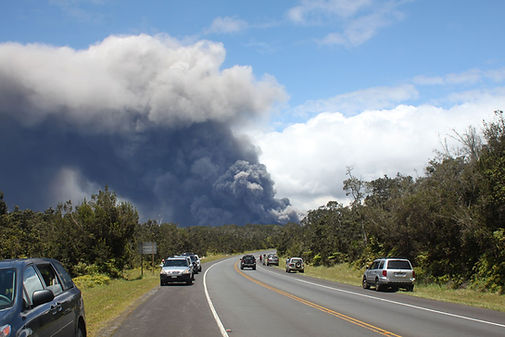
Taken near the entrance of Hawai`i Volcanoes National Park (which is now closed) on May 15, 2018, at 11:28 am.
MORTON GNEISS
Morton, Minnesota
Oldest Rock in the United States — 3.524 billion years old
MORTON GNEISS
Morton, Minnesota
Oldest Rock in the United States — 3.524 billion years old
Kilauea Volcano
10 Questions About the Earth—
and the Geology of North America.
Science — History — Biography
THE WAVE, ARIZONA
Navajo Sandstone
Arid Climate of the Supercontinent Pangea
The Navajo Sandstone is the third rung on a climb up the Grand Staircase. It is on grand display as the steep massive walls at Zion National Park in Utah. It forms the photogenic convulsions in the landform known as The Wave in northern Arizona. It covers much of northern Arizona, eastern Utah, western Colorado and southwestern Wyoming. A section of it in California is known as the Aztec Sandstone. In Wyoming it is the Nugget Sandstone. But it is all the result of the same intense climate conditions: the prolonged period of an extremely arid climate that happened in the middle of a supercontinent. In this case, the supercontinent was Pangea.

Navajo Sandstone forms the massive walls at Zion National Park, Utah.

Navajo Sandstone as The Wave in northern Arizona.
A supercontinent forms when all of the major continental landmasses assemble into one massive continent. The first supercontinent was Columbia (sometimes called Nuna). It existed from 1.9 to 1.6 billion years ago. Then came Rodinia from 1.1 to 0.7 billion years. Then came the third, Pangea, which was assembled by 0.3 billion years ago and lasted about 0.1 billion years. [NOTE: Gondawana was almost a supercontinent, but it did not include the continental mass that is now North America or Western Europe.]
The climate of a supercontinent is intense because much of the continental mass is far from the ocean, and so the climate across most of a supercontinent is extremely arid because rain storms that originate over the ocean cannot travels into the deep interior. And that is what the Navajo Sandstone represents: A time when Pangea existed and, for tens of millions of years, small amounts of rain fell across the interior. And so massive sand dunes formed.