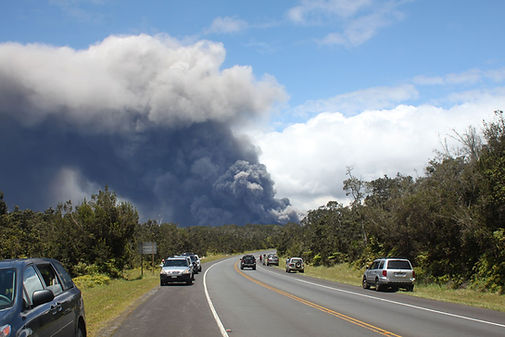
Taken near the entrance of Hawai`i Volcanoes National Park (which is now closed) on May 15, 2018, at 11:28 am.
MORTON GNEISS
Morton, Minnesota
Oldest Rock in the United States — 3.524 billion years old
MORTON GNEISS
Morton, Minnesota
Oldest Rock in the United States — 3.524 billion years old
Kilauea Volcano
10 Questions About the Earth—
and the Geology of North America.
Science — History — Biography
BLACK HILLS, SOUTH DAKOTA
Mount Rushmore
Final Growth of the Rocky Mountains
The Black Hills of South Dakota is one of the youngest mountains ranges on the continent. They rose about 40 million years ago. And they are positioned near the center of the continent. Which presents a dilemma: According to the theory of plate tectonics, the outer part of the Earth consists of a rigid tectonic plates that slowly move across the planet's surface. Where two plates collide, they push up the ground and a mountain range forms. But the Black Hills are more than a thousand miles from the nearest plate boundary, which lies along the western coast of North America. So why did the Black Hills form so far from a plate boundary—and so recently?
The Black Hills is the easternmost extent of the Rocky Mountains, a mountainous terrain that began to form about 80 million years ago—which is also far from a plate boundary. The Rocky Mountains grew because the tectonic plate that is sliding beneath North America‚ the Farallon Plate, shifted its position upward. The upward movement was due to the buoyancy of the plate. (To put it simply, the Farallon Plate is an ancient oceanic plate. A section of it contains a huge plateau of erupted lava. That plateau is less dense than the Earth's mantle, and so, it has caused that section of the Farallon Plate to rise by buoyancy.)

Mount Rushmore is the most famous part of the Black Hills. Look at the portraits of the four stone sculptures. They are carved into a light-gray granite that solidified deep inside the Earth 1.7 billion years ago.
Look below George Washington. There is a band of black rocks with a texture that sweeps up and to the left. This is a metamorphic rock known as a schist. The schist was originally ocean sediments that formed earlier than the granite. The sediments were buried, then heated by the once-molten granite and changed into the schist. The granite and the schist, still deep inside the Earth, were then covered by a succession of sedimentary rocks: first a limestone, then a shale and finally and sandstone.


The entire assemblage—granite and schist, limestone, shale and sandstone—was then pushed upward by the extra buoyancy in the Farallon Plate. The result was the Black Hills of South Dakota. (Drawing courtesy of Alan H. Strahler, Boston University)